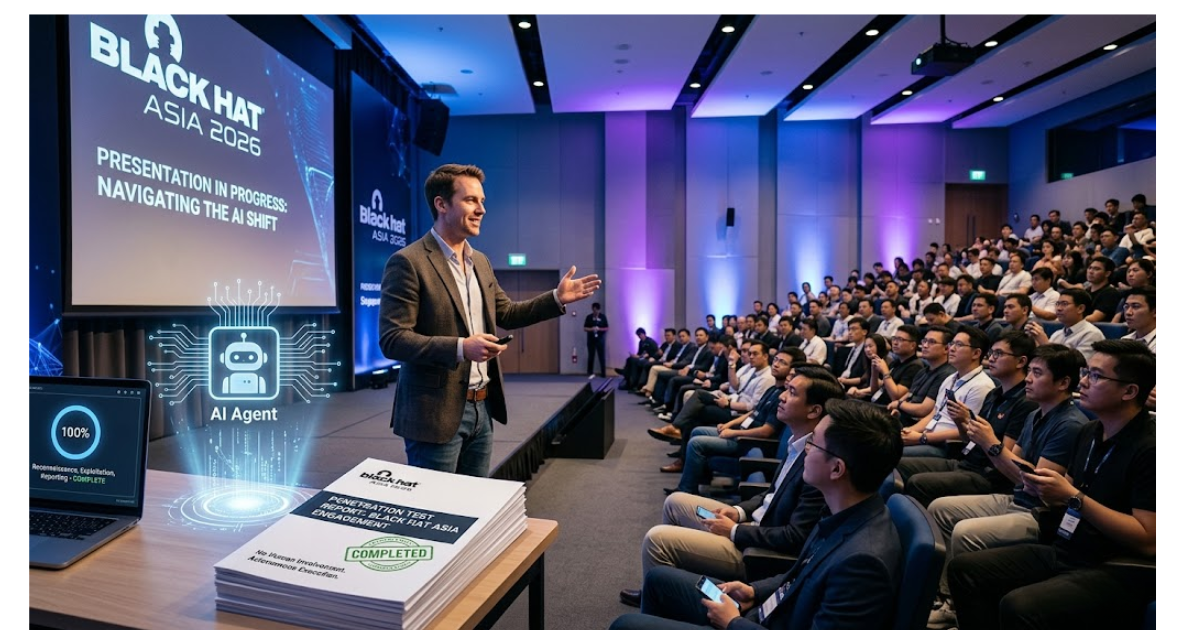
An AI agent walks into a penetration test at Black Hat Asia. By the time the presenter finishes his talk, the agent has completed the entire engagement — reconnaissance, exploitation, report. No human needed. If you work in cybersecurity, or are planning to, you need to understand what this means for your career right now.
- 1. The honest assessment, specialization by specialization
- 2. Specialization 01: Application Security & Malware Reverse Engineering
- 3. Specialization 02: Ethical Hacking & Penetration Testing
- 4. Specialization 03: SOC Analyst & Defensive Security
- 5. Specialization 04: Governance, Risk & Compliance (GRC)
- 6. Specialization 05: Identity & Access Management (IAM)
- 7. Specialization 06: Security Engineering & Cloud Security
- 8. The action plan: protecting your career
- 9. The field is changing. Your approach needs to change too.
- 10. Sources & References
Firefox vulnerabilities found by Claude Opus 4 AI — in two weeks
Unfilled cybersecurity positions globally right now
Rise in interest for GRC analyst roles over the past five years
Projected SOC analyst growth from 2023 to 2033
The question everyone in cybersecurity is quietly asking — is my job safe? — finally has a data-driven answer. Some specializations are at significant risk of being hollowed out by artificial intelligence. Others are not just safe; they are growing precisely because of AI. The difference between spending two years studying the wrong specialization and building a decade-long career comes down to understanding which is which.
This analysis covers every major cybersecurity domain, assessed against real-world evidence from industry practitioners, AI capability benchmarks, and current 2026 hiring data. No hype, no false comfort.
The honest assessment, specialization by specialization
Application Security & Malware Reverse Engineering
This is the domain making the most noise — and for good reason. Application security engineers, secure code reviewers, exploit developers, and malware reverse engineers are working in the exact areas where AI has demonstrated the most dramatic gains in capability.
In early 2026, Anthropic's Frontier Red Team partnered with Mozilla and — using Claude Opus 4 — discovered 22 novel vulnerabilities in Firefox over just two weeks, including 14 classified as high severity. That count represents nearly a fifth of all high-severity Firefox bugs patched throughout all of 2025. The AI also wrote working exploits for two of those bugs — going well beyond simple detection. Separately, The Hacker News reported that Claude found over 500 zero-day vulnerabilities across open-source projects — including the Linux kernel — with no custom scaffolding or specialized prompting.
This does not mean every application security role disappears overnight. It means the nature of the work transforms rapidly. Senior engineers will increasingly manage and orchestrate AI agents rather than perform the underlying analysis themselves. Junior and mid-level positions in this category are most vulnerable to displacement.
If you are already working in AppSec, invest immediately in understanding how AI agents operate and begin integrating them into your workflow. If you are a student or a career changer, do not start here. Entry-level opportunities will be significantly diminished within two years.
Ethical Hacking & Penetration Testing
Ethical hacking is the career aspiration that brings most people into cybersecurity. The romanticism around it is real — but so is the disruption. AI is now accelerating every phase of a modern penetration test: reconnaissance, social engineering simulation, vulnerability discovery, exploit development, and report writing.
A widely discussed demonstration at Black Hat Asia saw a security researcher deploy an AI agent at the start of his presentation — and by the time he finished, the agent had completed the penetration test. This is not a future scenario; it is industry reality in 2026. Security practitioners note that AI augmentation has already fundamentally changed how experienced testers approach their work.
There is also a structural reality that pre-dates AI: dedicated penetration testing roles have always been relatively scarce, with most organizations relying on contractors or shared functions rather than full-time internal pentesters. Betting an entire career on this single specialty was already risky. With AI amplifying the work, that risk has compounded.
Learning ethical hacking fundamentals is still worth doing — it makes you a better security professional across any domain. But do not begin your career here. Build broad skills first, secure employment in a more resilient specialization, then pursue penetration testing as a differentiating layer on top.
"In 2026, cybersecurity has become a business priority, not just a technical issue. GRC professionals help ensure compliance, manage risk in business terms, and guide safe technology adoption — making these roles more strategic and valuable than ever."
— ISC² GRC Practitioner Survey, January 2026 ·Read the full report →
SOC Analyst & Defensive Security
Conventional wisdom says SOC analysts will be the first cybersecurity workers replaced by AI because the job involves "just watching alerts." This conventional wisdom is wrong on multiple levels.
In practice, blue teams and defensive security professionals are among the busiest people in any organization's security structure — managing incident response, building detection logic, maintaining tool integrations, and conducting threat hunting. Cyber Security District's 2026 Workforce Report confirms that organizations globally still struggle to fill security roles fast enough, with demand exceeding supply and no sign of closing.
StationX's 2026 analysis puts global unfilled cybersecurity positions at 3.5 million, with SOC analyst roles expected to grow by 332% from 2023 to 2033 — nearly 28 times the rate for computer-related occupations overall. And the same AI capabilities that improve defensive tooling are being used by threat actors — criminal groups leveraging AI to launch faster, more sophisticated attacks at greater scale, creating more work for blue teams, not less.
There is also a major emerging skill gap: most candidates know how to analyze threats on a Windows endpoint, but few can detect data exfiltration happening purely via API calls in the cloud.[4] Mastering cloud-native SOC tools like Microsoft Sentinel and AWS GuardDuty creates a significant career moat.
For students and career changers, blue teaming is your best entry point into cybersecurity right now. Strong demand, clear learning paths, genuine AI resilience. For experienced SOC analysts, build depth in cloud-native detection — that is where the highest-value work is concentrating.
Governance, Risk & Compliance (GRC)
GRC is the most AI-resilient specialization in cybersecurity — and one of the fastest-growing. The work centers on risk assessment, regulatory compliance, organizational strategy, stakeholder management, and providing assurance to boards. These are fundamentally human activities requiring judgment, contextual knowledge, legal accountability, and interpersonal skill that AI cannot replicate.
The market data is unambiguous. EC-Council University and ZipRecruiter data show interest in cybersecurity GRC analyst roles has risen by nearly 1,000% over the past five years, with average US salaries reaching $99,400 annually as of April 2026, and senior roles like Director of Risk & Compliance exceeding $141,000.
ISC²'s 2026 practitioner survey found that GRC has become a C-suite priority — driven by AI adoption, cloud complexity, and intensifying global regulation. And the EU AI Act, now fully enforced in 2026, imposes fines of up to €35 million or 7% of global revenue for non-compliance — creating an entire new category of AI governance work that falls squarely in GRC's domain.
AI does assist with GRC tasks — summarizing policy documents, flagging audit anomalies. But it cannot replace the professional accountability that regulators and boards require. When a financial institution needs to demonstrate compliance with a framework, a qualified auditor's judgment and signature carry legal weight that an AI response cannot provide.
GRC is the highest-leverage upskill available to any cybersecurity professional today. For beginners, explore the GRC career pathway guide from ComplyJet and consider the ISO 42001 Lead Auditor certification for AI governance — currently one of the most in-demand credentials in the entire field.
Identity & Access Management (IAM)
IAM governs who can access what systems, applications, and data across an organization. As cloud adoption accelerates and zero-trust architectures become standard, IAM has evolved from a backoffice IT function into a critical security discipline with growing strategic importance.
AI will improve IAM tooling — faster access reviews, sharper anomaly detection, more automated provisioning. This will reduce headcount needed for routine administration. However, the complexity of enterprise IAM environments ensures ongoing demand for human expertise. ACSMI's 2026–2027 market analysis, citing Robert Half salary benchmarks, identifies identity and data protection among the areas commanding the strongest salary growth — because they combine technical credibility with direct business consequence.
IAM training is less accessible than other domains — most substantive learning happens through hands-on work with enterprise platforms like Okta, Microsoft Entra ID, and AWS IAM. But there is strong overlap with cloud security and GRC skills, making IAM a natural extension of those foundation areas.
Particularly valuable as a specialization layered on top of cloud security or GRC foundations. Not recommended as a primary entry point due to the enterprise tool experience required. Cloud security remains the highest-growth sub-domain within the IAM and security engineering landscape.
Security Engineering & Cloud Security
Security engineering is an enormously broad category spanning firewall management, cloud infrastructure security, network security, endpoint protection, and more. The risk profile varies dramatically depending on what kind of security engineer you are.
The most dangerous position: specializing deeply in a single legacy technology. Security engineers who have spent a decade mastering one specific firewall vendor or on-premises platform have historically been exposed when that technology becomes obsolete. With AI accelerating technology cycles, this risk is more acute than ever. IronCircle's 2026 Career Outlook confirms employers want proof of applied, transferable skills — not deep familiarity with one vendor's toolset.
Automation specialists — roles primarily involving writing scripts to automate security tasks — represent the highest-risk sub-category. Basic scripting is precisely what large language models do most convincingly, and organizations can increasingly achieve the same outcomes with AI-assisted tools operated by generalist professionals.
Cloud security, however, is a different story. ISC² identifies cloud security as the top skill demand heading into 2026, with cloud security roles among the fastest-growing and highest-compensated in the entire field.[13] Motion Recruitment's 2026 Tech Salary Guide confirms the cloud and IT services sector is entering 2026 as the most aggressive recruiter of cybersecurity talent
Avoid becoming a one-technology specialist. Breadth matters more than ever. Cloud security — particularly AWS, Azure, and GCP security architecture — is the highest-growth area. Targeted certifications like AWS Security Specialty or Microsoft's SC-200 are solid investments.
The action plan: protecting your career
Build a triad of core competencies
Defensive security (SOC), GRC, and cloud security — together, these three domains will insulate you against nearly any AI-driven shift. They represent the areas with the strongest demand and the most human-dependent work in 2026.
Learn AI by building, not certifying
Do not waste money on AI certification courses — these teach theory and lag years behind practice. Build and experiment with AI agents using tools like Claude and open-source agent frameworks. The professionals who thrive will be those who can direct AI to do security work.
Diversify before you specialize
The classic trap in security engineering is mastering one tool for years. ACSMI's 2026 market analysis confirms salary growth concentrates around people who solve expensive, cross-domain problems — not single-tool specialists.
Students: sequence your learning deliberately
Resist the pull toward ethical hacking or AppSec as a starting point. SOC analyst roles are consistently the top cyber job postings across the US — the clearest entry pathway with the lowest barrier to hire and the strongest long-term resilience.
Executive Summary
| SPECIALIZATION | AI Disruption Risk | Demand Trend | Best for Beginners? |
|---|---|---|---|
| App Security / Malware RE | HIGH | Declining (entry-level) | No |
| Ethical Hacking / Pentesting | MODERATE | Stable (senior only) | No |
| SOC Analyst / Blue Team | LOWER | Growing (+332% to 2033) | Yes ✓ |
| GRC | LOWEST | Rapidly growing (+1,000% interest) | Yes ✓ |
| Identity & Access Management | LOWER | Growing | Indirectly |
| Security Engineering (Cloud) | LOWER | Growing strongly | Yes ✓ |
| Security Engineering (Legacy / Automation) | HIGH | Declining | No |
The field is changing. Your approach needs to change too.
The professionals who will thrive in AI-era cybersecurity are not those with the narrowest depth in the most exciting specializations. They are the ones with broad foundations, genuine adaptability, and the ability to leverage AI as a force multiplier for human judgment.
Is cybersecurity still a good career choice in 2026?
Yes — but more nuanced than five years ago. With 514,000+ US job postings and 26% of positions still unfilled, demand continues to outpace supply significantly. AI-resilient specializations like GRC, cloud security, and defensive security are growing faster than the overall market. The professionals who approach this with clear-eyed strategy will find more opportunity, not less.
Should beginners get cybersecurity certifications in 2026?
Certifications remain useful as signals for certain roles, particularly in GRC (ISO 27001, CISM) and cloud security (AWS Security Specialty, Microsoft SC-100). For AI specifically, skip the certification market entirely — it lags real-world practice by years. ISC² identifies AI/ML as the top skill need in cybersecurity, but the best way to gain it is through hands-on practice, not coursework.
Will AI make cybersecurity easier or harder?
Both, simultaneously. AI makes individual practitioners more productive and compresses detection time. It also makes threat actors more capable and lowers the barrier to launching sophisticated attacks. Cybercrime is predicted to cost the world $12.2 trillion annually by 2031 — meaning continued, compounding demand for skilled human professionals who can navigate this complexity.
Sources & References
Anthropic. (6 March 2026). Partnering with Mozilla to improve Firefox's security.
https://www.anthropic.com/news/mozilla-firefox-securityInfoQ. (March 2026). AI Model Discovers 22 Firefox Vulnerabilities in Two Weeks.
https://www.infoq.com/news/2026/03/claude-ai-firefox-vulnerability/The Hacker News. (7 March 2026). Anthropic Finds 22 Firefox Vulnerabilities Using Claude Opus 4 AI Model.
https://motasemhamdan.medium.com/cybersecurity-in-2026-still-worth-your-time-and-your-career-7ac9c70f9ec4Hamdan, M. (January 2026). Cybersecurity in 2026: Still Worth Your Time (and Your Career)? Medium.
https://motasemhamdan.medium.com/cybersecurity-in-2026-still-worth-your-time-and-your-career-7ac9c70f9ec4CyberSecJobs. (2026). Cybersecurity Jobs in 2026: The Complete Guide to Roles, Salaries & Clearance Paths.
https://cybersecjobs.com/cybersecurity-jobs/Cyber Security District. (January 2026). Cybersecurity Workforce Trends for 2026.
https://www.cybersecuritydistrict.com/cybersecurity-workforce-trends-for-2026/StationX. (January 2026). Are SOC Analysts in Demand in 2026? — citing BLS growth projections.
https://www.stationx.net/are-soc-analysts-in-demand/EC-Council University. (April 2026). Why GRC Has Become a Top Cybersecurity Career Path in 2026. — citing ZipRecruiter salary data.
https://www.eccu.edu/blog/grc-cybersecurity-career-path-2026/ISC². (January 2026). Cybersecurity Moves from Threat to Risk: GRC Challenges and Opportunities.
https://www.isc2.org/Insights/2026/01/grc-challenges-and-opportunitiesCyber Sierra. (December 2025). Top AI-Powered GRC Trends to Watch in 2026. — includes EU AI Act compliance context.
https://cybersierra.co/blog/ai-grc-trends-2026/Try our Security & Hash Tools: Password Checker