Introduction
In 2026, paid acquisition costs on LinkedIn are up 24% year-over-year while organic content-sourced pipeline share has climbed from 22% to 27%. Sound familiar? You're watching your CAC inflation spiral while competitors shift budgets away from ads. But here's the thing: the companies that are winning right now aren't abandoning paid. They're building systematic content strategies that compound.
Content marketing generates roughly $3 in return for every $1 spent—and that's just the beginning. The real magic happens when you stop thinking about content as a "blog" and start thinking about it as your product distribution system.
This playbook covers the framework that's working in 2026: how to define your buyer, choose high-converting content types, align distribution channels, and measure pipeline impact. Whether you're a bootstrapped startup or a Series B SaaS company, the principles are the same. The execution varies.
Key Takeaways
- Content marketing ROI averages 702% over 3 years with a 7-month break-even (First Page Sage, 2026)
- Median CAC for content-sourced customers is $2,640 vs. $4,180 for paid—37% cheaper (SaaS Marketing Benchmarks, 2026)
- Organic + AEO pipeline share climbed from 22% to 27% as paid CPL inflation drives reallocation (B2B SaaS Benchmarks, 2026)
The 2026 SaaS Content Shift: From Blog Factory to Product-Led Authority
In 2025, generic educational content lost 40% of its SEO value. In 2026, the winners are companies weaving their product into every narrative. That's "Product-Led Content"—and it's the only content strategy that still works at scale.
Think about it. Your prospect can ask ChatGPT "How do I manage remote teams?" and get a polished answer in seconds. What they can't get is "How to build a remote workflow in [Your Product Name] in 10 minutes." That gap is where your content wins.
Here's the data backing this shift: Median CAC for content-sourced customers is $2,640 versus $4,180 for paid channels (SaaS Marketing Benchmarks, 2026). That's not because content is magical. It's because product-led content filters for intent earlier in the funnel.
The mistake most SaaS founders make? They publish 50 generic blog posts hoping one converts. The smart money publishes 5 product-integrated case studies that pre-sell the buyer before they ever talk to sales.
Why is 3-year ROI (844%) so different from year-one ROI (260%)? Most SaaS content teams quit in year 2. They don't see immediate pipeline impact. They reallocate to paid. But content is compounding. Your first 12 posts build traffic. Your next 12 posts amplify that traffic. By month 20–24, you're no longer fighting for visibility; you're capturing intent nobody else is chasing.
Define Your Buyer Personas and Content Pillars
Here's the hard truth: 79% of B2B content marketers who succeed start with audience definition—not content calendars, not posting schedules. They define who they're talking to.
79% of B2B content marketers believe understanding their audience is critical to success (Content Marketing Institute, 2026). And yet most founders skip this step. They write for "SaaS buyers" (a persona that doesn't exist). Then they wonder why nobody engages.
Run 10–15 customer interviews. Ask three questions:
- What problem led you to look for a solution? (This tells you the pain point before they knew your product existed.)
- What almost stopped you from signing up? (This reveals objections you need to address in content.)
- What do you love most about us now? (This tells you what outcome your product delivers.)
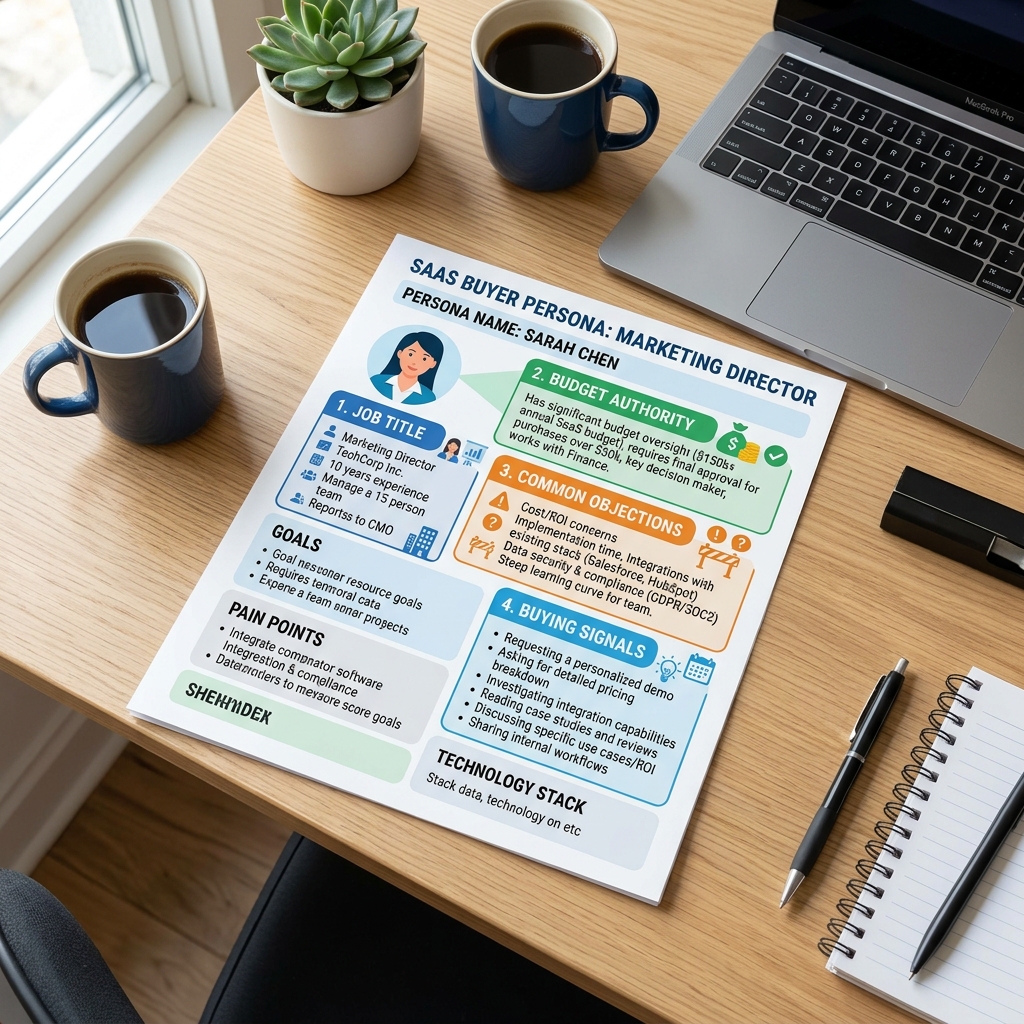
From those interviews, build 3–5 buyer personas with explicit attributes: job title, reporting line, budget authority, media consumption, objections, and buying signals.
When we mapped personas for a mid-market SaaS client, we discovered their CFO cared about implementation risk, not features. Their VP of Engineering cared about API flexibility. The Head of CS cared about reporting. Single content piece doesn't sell to all three. Different personas need different proof points.
Map each persona to the content they consume at each funnel stage. This isn't guesswork—ask them: "How do you research solutions? What blogs do you read? Do you watch YouTube?" Then prioritize content types and channels accordingly.
Map Your Content Framework: FMoFU x Content Type Matrix
The best SaaS content strategies align content type to buyer journey stage. Not just to "we need more content." To specific stages with specific goals.
Here's how the matrix works:
Top-of-Funnel (Awareness): Your buyer doesn't know they have a problem yet. Content: Industry reports, trend analysis, thought leadership, educational blog posts. Goal: Build authority, capture intent.
Mid-Funnel (Consideration): They know their problem. They're comparing solutions. Content: Product workflows, comparison guides, case studies, webinars. Goal: Demonstrate product fit, build credibility.
Bottom-of-Funnel (Decision): They're evaluating you specifically. Content: Feature breakdowns, ROI calculators, customer testimonials, competitor comparisons. Goal: Close deals.
Post-Purchase (Retention): They bought. Now what? Content: Knowledge base, onboarding guides, advanced use-case webinars, community forums. Goal: Drive expansion and reduce churn.
The power of this framework? It forces you to stop publishing randomly. Every piece of content has a job. And you measure whether it does that job.
High-ROI Content Types: What Actually Converts
Here's the uncomfortable truth: competitor vs. your product pages and alternatives guides have the highest conversion rates of any SaaS content type. Not blog posts. Not whitepapers. Not thought leadership. Comparison content.
Why? Because when a prospect is comparing you to five other tools, you win by being transparent about what you do (and what you don't). You win by answering their unspoken question: "Should I buy you instead?"
Case studies and customer success stories influence 91% of B2B buying decisions (Demand Gen Report, 2026). But not all case studies. The ones that work have three components:
- Specific numbers. Not "revenue increased." "Revenue increased 127% in 8 months" with the exact methodology so the reader can replicate it.
- Customer profile match. The case study customer should look like your target buyer. If you're selling to enterprise but your case study is about a 10-person startup, it doesn't move the needle.
- Product-in-the-narrative. The customer didn't succeed because of your product. But they succeeded using your product in a specific way. That distinction matters.
Other high-ROI content types:
- Product-led walkthroughs: Instead of "7 ways to manage remote teams," write "How to set up a remote workflow in [Your Product] in 10 minutes." Weave your product into every step.
- ROI-focused technical breakdowns: CFOs care about payback period. Engineers care about implementation risk. Write content that addresses both.
- Competitive deep-dives: "Slack vs. Teams for remote teams" ranks better than "Best tools for remote teams" and filters for intent earlier.
2026 Channel Mix: Why Organic + AEO Is Beating Paid
Here's what's changed: Paid pipeline share fell from 34% to 26% in three years. Organic and AI-enabled search (AEO) climbed from 22% to 27%. That's not a trend. That's a structural shift in how buyers discover solutions.
Why? Three forces:
- CPL inflation. LinkedIn CAC is up 24% YoY. Google is up 19% YoY. You're paying more to reach the same audience.
- Answer engines. ChatGPT, Perplexity, and Claude cite organic content—not ads. If your content doesn't rank, it doesn't get cited.
- Declining organic reach. LinkedIn's organic reach for branded posts dropped 40% in 2025. Teams are shifting budget to SEO and content because paid channels are exhausted.
What does this mean for budget allocation? If you're still 60/40 paid-to-organic, you're overweighting a declining channel. The math suggests reallocating 10–15 points from paid toward content and SEO.
Budgeting, Staffing, and Timeline: Realistic Numbers for 2026
Let's talk money. The median SaaS company spends between $342,000 and $1,090,000 per year on content marketing. Where does that land in your range?
For context: 65% of SaaS teams invest more than $3,000 per month ($36,000+/year). 79.2% of teams expect at least a slight budget increase in 2026, with 21.2% expecting a significant increase. Translation: your CFO knows content matters. She's asking where the ROI is.
Here's what that ROI timeline looks like:
Months 1–3 (Setup phase): You're defining buyer personas, publishing your first 5 pillar pieces, and establishing measurement. Traffic is flat. Don't expect pipeline impact yet.
Months 4–7 (Traction phase): Traffic climbs. You're getting 20–30% month-over-month growth in organic visitors. You see your first content-sourced MQLs. This is where the 7-month break-even happens.
Months 8–24 (Compounding phase): Your first batch of content is now ranking for 3–4 keywords each. You're publishing new content and amplifying old content. Pipeline contribution is now predictable (you know your conversion rate). This is where most teams see 3–5x ROI.
Year 3+: You stop measuring by individual pieces. You measure by "content team's monthly pipeline contribution." ROI is now 844% (compounding).
Why do teams quit in year 2? Because they don't see month-10 results looking like month-24 results. But that's the compounding effect. Content doesn't peak at month 10. It peaks at month 24 and beyond.
Execution: Building Your Content Delivery System
Winning SaaS teams don't operate on "random blog post Friday." They use OKRs and dashboards to tie every asset to SQL.
Here's the system:
Step 1: Set Content OKRs (Weeks 1–2)
- Objective: "Build content-driven pipeline for [product segment]"
- Key Results:
- Drive 15,000 organic visitors to blog by month 6
- Generate 50 content-sourced MQLs by month 6
- Achieve $500K in pipeline contribution by month 12
Step 2: Build Your Editorial Calendar (Weeks 3–4)
- 12-month roadmap aligned to your buying cycle
- 20–30 pillar pieces + 40–60 spoke articles
- Mix of product-led, comparison, and educational content
- Seasonal angles if relevant to your vertical
Step 3: Use AI (But Smartly) 87% of teams using AI for content creation report higher productivity. 67% save 10+ hours per week. But here's the catch: AI is best for research synthesis and outlining—not for original insights or product-specific narrative.
Use AI to: Synthesize competitor research, generate 5 outline options, draft FAQ sections, repurpose content into social posts.
Don't use AI for: Writing your unique product narrative, case study authoring, technical explanations, or anything that needs your original opinion.
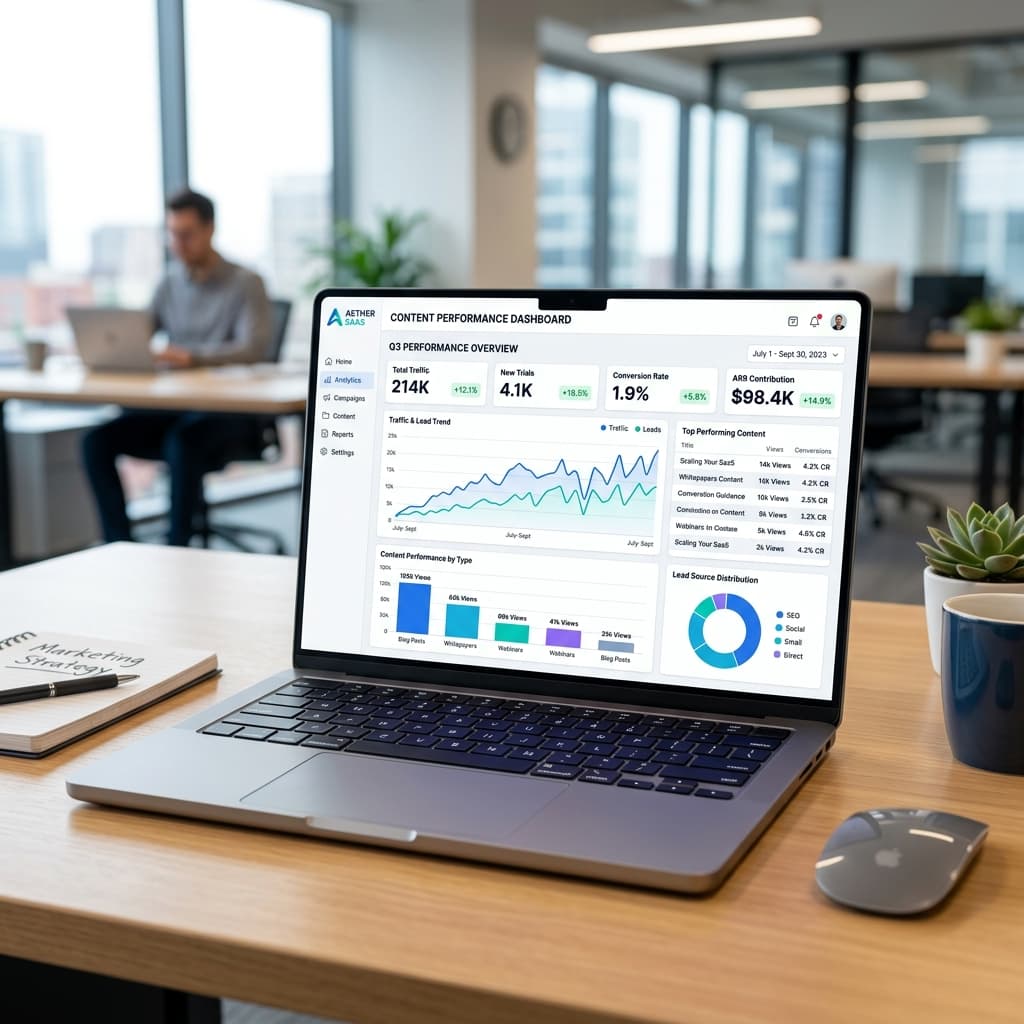
Step 4: Measure Against a Dashboard Track these KPIs monthly:
- Organic traffic (month-over-month growth, target: 20–30%)
- Content conversion rate (from visitor → MQL, target: 2–4%)
- Average time on page (indicator of engagement, target: 2+ min)
- Internal CTR (indicator of internal linking health)
- Pipeline sourced from content (tied to your CRM)

Distribution & Amplification: From Publish to Pipeline
Here's the hard truth: great content with no distribution is just a blog post in a vacuum. The difference between a viral post and a pipeline-driving post isn't content quality—it's distribution.
Your distribution strategy should mirror your buyer persona. If your buyer reads Reddit but never uses Twitter, why would you thread on Twitter?
Multi-channel playbook:
SEO/Organic Search (Primary channel)
- Optimize titles, headings, and meta descriptions for your primary and secondary keywords
- Internal link from topical clusters (related pieces linking to each other)
- Get backlinks from industry publications and partner sites
- Refresh evergreen content monthly with new statistics and case studies
LinkedIn (Best for B2B SaaS)
- Post a thread (5–7 tweets in thread format) breaking down key insights from your article
- Best posting time: 8 AM Tue–Thu for SaaS audience
- Engagement hook: Start with a contrarian take ("Paid content marketing is dead") then pivot to the data
- Link to full article in the final post, not the first
- 2-part nurture: Part 1 = TL;DR + top 3 stats (teaser link). Part 2 (3 days later) = "Your 12-week implementation roadmap" (downloadable template behind gate)
- Segmentation: Send to cold segment, warm segment, and customer segment separately with different CTAs
- Goal: Not just traffic, but qualified traffic that's ready to buy
Reddit & Communities
- Find relevant subreddits: r/startups, r/marketing, r/SaaS
- Post as "value-first comment," not direct link drop
- Example: "Saw people in this community asking about SaaS content ROI. We tracked this for 50+ clients. Here's what worked..."
- Only if the subreddit rules allow (read the sidebar first)
YouTube (High ROI, Long Shelf Life)
- Companion video: 8–12 min breakdown of your article's main H2s
- Titles include primary keyword: "How to Build a SaaS Content Strategy That Drives Pipeline (2026)"
- Chapters break on H2s for searchability
- End screen links to full article
One piece of research becomes: one blog article, one YouTube video, five LinkedIn posts, two Reddit comments, one email sequence, and six social tiles. That's 6-week content distribution for 3 days of creation.
FAQ Section
How long until my SaaS content marketing shows ROI?
SEO-driven content breaks even in approximately 7 months and compounds to 844% ROI over 3 years. Early months (1–3) show traffic growth; pipeline contribution appears in months 4–7 (First Page Sage, 2026 benchmarks). Most teams quit in month 8–10 when they don't see immediate payoff. The teams that win are the ones with 24-month budgets.
Should we use AI to write our SaaS content?
87% of marketers using AI for content creation report higher productivity and 67% save 10+ hours per week (MarTech Survey, 2026). Use AI for first drafts, research synthesis, and distribution. Reserve human expertise for strategy, original examples, and fact-checking. Never publish AI-first drafts without heavy editing for accuracy and voice.
What content type drives the most conversions for SaaS?
Competitor comparisons and case studies convert highest at bottom-of-funnel. For pipeline attribution, content pieces that mention your product directly have 3–5x better conversion than generic educational posts (SaaS Marketing Benchmarks, 2026). Product-led content is the differentiator.
How do we measure content attribution to pipeline?
Use UTM parameters on all content, track first-touch and multi-touch attribution in your CRM, and audit your analytics dashboard monthly. Aim to tie content output directly to SQL volume, not just traffic metrics. Detailed measurement frameworks help you understand which content sources drive real business results.
Conclusion
Here's what the 2026 playbook boils down to:
- Start with buyer personas, not content calendars
- Choose product-led content types that integrate your product into the narrative
- Publish 5 pillar pieces + 10 spoke articles before measuring ROI
- Reallocate 10–15% of paid budget toward organic and AEO
- Measure pipeline, not vanity metrics. Traffic doesn't matter; qualified pipeline matters
- Play the 3-year game. Content compounds. Year 1 is setup. Year 2 is traction. Year 3 is ROI
Ready to build your 2026 SaaS content program? Start with your buyer personas this week (interviews, not guesses). Map your content framework next week. Launch your first 5 pillar pieces in the next 6 weeks. Then measure and iterate.
The companies that win at SaaS content aren't the ones with the biggest budgets. They're the ones with clarity about their buyers and patience with compounding returns.
Sources
- B2B SaaS Content Marketing Strategy That Drive Leads in 2026 – Position Digital
- SaaS Content Marketing Strategy 2026: Drive Real Growth – Growth Minded Marketing
- 2026 SaaS Content Marketing Trends: Navigating the Era of Agentic Growth and Product-Led Authority – 12AM Agency
- SaaS Marketing Statistics 2026: 150+ Data and Trends – Digital Applied
- 60+ Hand-Picked SaaS Content Marketing Statistics for 2026 – Ranklyx
- How to Create a SaaS Content Strategy That Drives Product Signups – Grow and Convert
- 7-Step SaaS Content Marketing Guide for 2026 – SimpleTiger
- First Page Sage Content Marketing ROI Report 2026 – First Page Sage
- Demand Gen Report 2026 – Demand Gen Report
Ready to outrank your competition?
We help Nepali businesses build high-converting websites and dominant SEO strategies tailored for the local market.
Last updated: June 5, 2026