The Only Copywriting Tips Guide You’ll Ever Need to Write Words That Sell
Writing content is easy. Writing content that grabs attention, builds trust, and convinces people to take action is the real challenge.
Whether you’re creating blog posts, website copy, social media captions, sales pages, or email campaigns, strong copywriting can completely transform your business results.
In this guide, you’ll learn powerful copywriting tips used by professional marketers, brands, and content creators to increase conversions and keep readers engaged.
What Is Copywriting and Why Does It Matter?
Copywriting is the art of writing words that persuade people to take a specific action. That action could be:
Buying a product
Signing up for a service
Clicking a button
Joining a newsletter
Downloading a guide
Sharing content online
Good copywriting helps businesses:
Increase sales
Improve website engagement
Build customer trust
Improve SEO rankings
Generate more leads
Boost brand awareness
In today’s digital world, businesses that communicate clearly and emotionally almost always outperform those that don’t.
15 Powerful Copywriting Tips to Improve Your Content
Tip #1 — Master the Headline Before Anything Else
Your headline is the first thing readers notice. If your headline is weak, people won’t read the rest of your content.
A strong headline should:
Spark curiosity
Promise value
Solve a problem
Use emotional triggers
Include relevant keywords
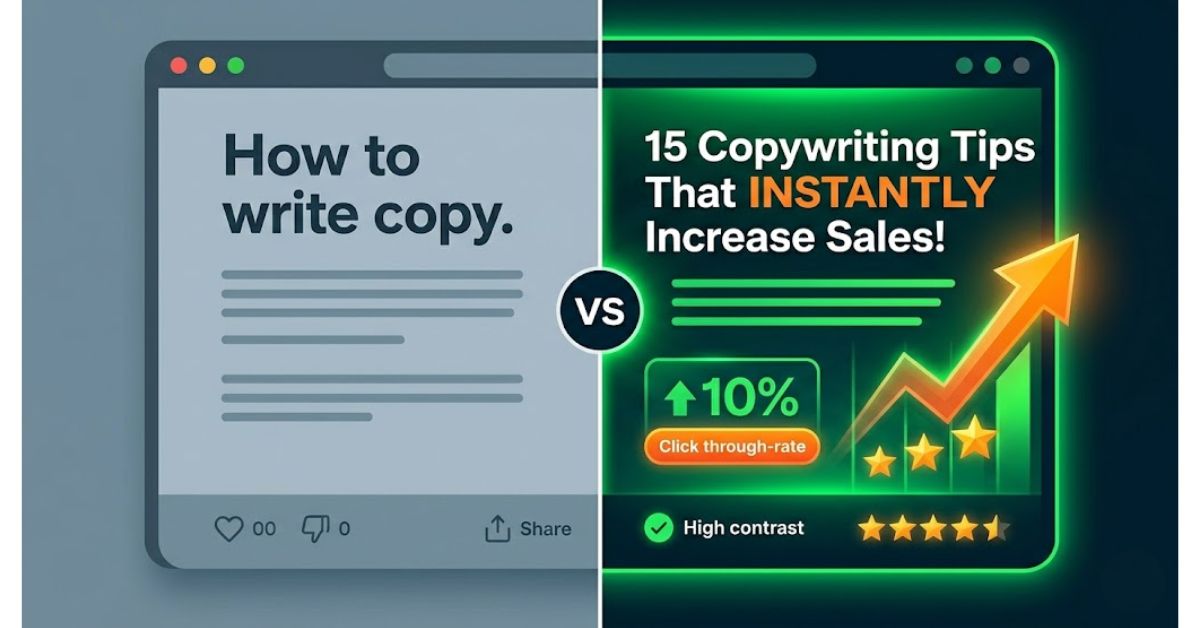
Examples of Strong Headlines
15 Copywriting Tips That Instantly Increase Sales
The Ultimate Guide to Writing Content That Converts
Why Most Website Copy Fails (And How to Fix It)
How to Write Better Marketing Copy in Less Time
SEO Tip
Include your primary keyword naturally in the headline to improve search engine visibility.
Tip #2 — Write for Humans, Not for Search Engines
Many beginners make the mistake of stuffing keywords everywhere. Modern SEO focuses more on helpful, user-focused content.
Instead of writing robotic content, write naturally and conversationally.
Bad Example
"Best copywriting tips copywriting guide best content writing tips for marketing copywriting."
Better Example
"These copywriting tips will help you create clearer, more persuasive marketing content that connects with your audience."
Best Practice
Use keywords naturally in:
Headlines
Subheadings
Meta descriptions
First paragraph
Image alt text
URL slug
Tip #3 — Use the AIDA Framework Like a Pro
One of the most effective copywriting formulas is AIDA:

A — Attention
Grab the reader immediately with a strong hook.
I — Interest
Keep readers engaged by explaining the problem or opportunity.
D — Desire
Show benefits and create emotional appeal.
A — Action
Tell readers exactly what to do next.
This framework works exceptionally well for:
Landing pages
Sales pages
Ads
Email marketing
Product descriptions
Tip #4 — Focus on Benefits, Not Features
People care more about outcomes than technical details.
Feature
"This laptop has a 5000mAh battery."
Benefit
"Work all day without worrying about charging your laptop."
Benefits help readers imagine how their life improves after using your product or service.
Quick Formula
Feature + Outcome + Emotion = Stronger Copy

Tip #5 — Write Shorter Sentences
Online readers scan content quickly.
Large blocks of text reduce readability and increase bounce rates.
To improve readability:
Use short paragraphs
Break up long sentences
Add bullet points
Use subheadings frequently
Keep language simple
SEO Advantage
Readable content improves user experience, which can positively impact search rankings.
Tip #6 — Use Emotional Triggers
People buy emotionally and justify logically.
Strong copy often triggers emotions such as:
Fear
Excitement
Trust
Curiosity
Relief
Confidence
Belonging
Example
Instead of:
"Our software improves workflow."
Try:
"Stop wasting hours on repetitive tasks and finally focus on growing your business."
Tip #7 — Build Credibility with Social Proof
Trust is one of the biggest factors in conversions.
Add:
Testimonials
Reviews
Case studies
Success stories
Statistics
Client logos
Example
"Trusted by over 10,000 businesses worldwide."
Social proof reassures readers that your product or service actually works.

Tip #8 — Create a Strong Call to Action (CTA)
Never assume readers know what to do next.
A strong CTA should be:
Clear
Specific
Action-oriented
Easy to understand
Examples of Strong CTAs
Start Your Free Trial Today
Download the Free Guide
Book Your Demo Now
Get Instant Access
Learn More
Weak CTAs reduce conversions.
Always guide readers toward the next step.
Tip #9 — Use Storytelling to Connect Emotionally
Stories make your content memorable.
Instead of only presenting facts, explain:
Challenges
Experiences
Transformations
Real-world examples
Example
"After struggling to get clients for months, Sarah changed her website copy and doubled her sales within six weeks."
Stories help readers relate emotionally to your message.
Tip #10 — Understand Your Target Audience
Before writing anything, understand:
What your audience wants
Their biggest pain points
Their goals
Their fears
Their motivations
The better you understand your audience, the more persuasive your copy becomes.
Helpful Questions
What problem are they trying to solve?
What frustrates them most?
What transformation do they want?
What language do they use?
Tip #11 — Optimize Content for SEO
SEO copywriting helps your content rank higher in search engines.
Important SEO Practices
Use your main keyword naturally
Add internal links
Add external authority links
Optimize images
Write compelling meta descriptions
Use proper heading structure
Improve page speed
Make content mobile-friendly
Example Keyword Placement
Primary keyword: "copywriting tips"
Use it naturally throughout the article without keyword stuffing.
Tip #12 — Write Like You Speak
Conversational writing feels more authentic.
Avoid overly complicated words unless necessary.
Instead of
"Utilize advanced methodologies to optimize communication strategies."
Say
"Use proven strategies to improve your messaging."
Simple writing increases engagement and readability.
Tip #13 — Edit Ruthlessly
First drafts are rarely perfect.
Great copywriters spend significant time editing.
When editing:
Remove unnecessary words
Simplify complex sentences
Improve clarity
Eliminate repetition
Fix grammar mistakes
Improve flow
Pro Tip
Read your content out loud. If it sounds awkward, rewrite it.
Tip #14 — Use Power Words Carefully
Power words trigger emotion and attention.
Examples include:
Proven
Exclusive
Secret
Instant
Ultimate
Guaranteed
Powerful
Easy
Free
Fast
Use them strategically without sounding spammy.
Tip #15 — Keep Testing and Improving
Copywriting is not guesswork.
Test different:
Headlines
CTAs
Landing page layouts
Email subject lines
Ad copy
Product descriptions
Small changes can dramatically improve conversion rates.
Common Copywriting Mistakes to Avoid
Keyword Stuffing
Using keywords excessively hurts readability and SEO.
Writing Without a Goal
Every piece of content should have a clear objective.
Ignoring Audience Intent
Content should solve the reader’s specific problem.
Weak Headlines
A boring headline reduces clicks and engagement.
No CTA
Always guide readers toward an action.
Final Thoughts
Great copywriting is a combination of psychology, clarity, emotion, and strategy.
The best copy doesn’t just sound good — it drives action.
By applying these copywriting tips consistently, you can:
Improve conversions
Increase engagement
Build stronger brand trust
Generate more leads
Grow your business faster
Whether you’re a blogger, marketer, entrepreneur, or business owner, learning copywriting is one of the most valuable skills you can develop.
What are the most important copywriting skills?
The most important skills include persuasive writing, audience research, storytelling, SEO optimization, and emotional communication.
How do beginners improve copywriting?
Beginners can improve by reading successful copy, practicing daily, studying marketing psychology, and rewriting existing ads or sales pages.
Is SEO important in copywriting?
Yes. SEO helps your content rank in search engines while copywriting helps convert visitors into customers.
What is the best copywriting formula?
AIDA (Attention, Interest, Desire, Action) is one of the most effective and widely used copywriting formulas.
Read our full blogs here: https://fossatechnology.com.np/blog
Last updated: May 8, 2026